EN
EN
 fr
fr  de
de  es
es  it
it  ru
ru  pt
pt  ar
ar  id
id  ms
ms  uk
uk 








We have cooperated with more than 200 countries in solar energy projects and road lighting projects. We have exported products to many countries and participated in many important government projects around the world.













We have cooperated with more than 200 countries in solar energy projects and road lighting projects. We have exported products to many countries and participated in many important government projects around the world.

Anern has 17 years of experience in solar lighting and solar product manufacturing. Anern is headquartered in Guangzhou. With a production base of 30,000 square meters, our company has an R&D team of more than 100 people.
As of 2026, Nevada solar incentives rely mainly on the 30% Federal Solar Tax Credit for systems installed before the end of 2025, utility net metering or net billing credits (~75% of retail rate), and select battery storage rebates from utilities. Nevada does not offer a statewide solar income tax credit, and sales/property tax exemption programs are limited and vary by locality. Solar incentives can still deliver meaningful savings, especially when paired with a solar + battery system.
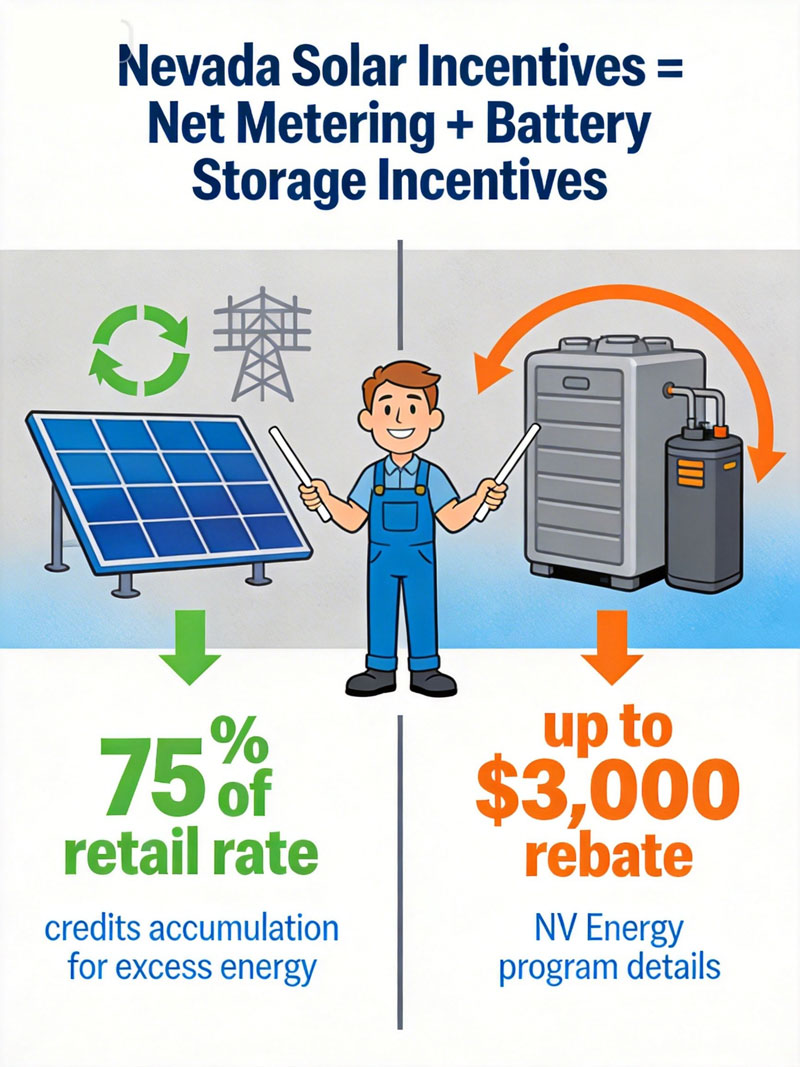
Nevada solar incentives include:
Federal Solar Tax Credit (ITC) — 30% credit, only for systems installed before the end of 2025
Net Metering / Net Billing Credits — export credits, typically ~75% of retail rate for NV Energy customers
Battery Storage Incentives — utility rebates when paired with solar (limited/paused in some cases)
Solar Access Rights & HOA Protections — homeowners may install solar without unreasonable HOA restrictions
Potential Property/Local Incentives — some local programs or abatements exist but are limited
What Nevada Does Not Offer:
A statewide solar income tax credit
A guaranteed statewide sales or property tax exemption for all solar systems
The federal Investment Tax Credit (ITC) historically allows homeowners to deduct 30% of the total installed solar system cost on federal taxes.
Applies to systems placed in service before December 31, 2025.
Includes pv panels, solar inverters, solar batteries, and solar installation labor.
Can be combined with other rebates or credits.
⚠ IMPORTANT: The federal residential solar tax credit (Section 25D) was repealed for systems installed after 2025. Therefore, systems installed in 2026 or later do not qualify for this credit unless grandfathered under prior guidance.
Nevada’s main state‑level solar incentive is net metering or net billing:
Excess solar energy sent back to the grid earns credits on your utility bill.
Most NV Energy customers are enrolled in a net billing credit program where exported energy is credited at approximately 75% of the retail electricity rate.
Credits typically roll over month‑to‑month indefinitely, but they vary by utility.
Net metering programs may differ for smaller utilities like Valley Electric Association or Overton Power District #5, but they generally allow excess energy credits.
What This Means:
If you generate more solar energy than you use during the day, the utility will apply those credits to your future electric bills. However, credits are not equal to full retail value — they are typically around 75% — and many utilities no longer guarantee 1:1 retail net metering.
Some Nevada utilities have offered battery storage rebates to customers who install solar + battery systems:
NV Energy’s program provided rebates up to $3,000 and varied based on time‑of‑use (TOU) plan participation.
Rebate amounts historically depended on battery size and rate structure.
⚠ Note: Certain battery incentive programs have paused or reached funding limits; check your utility’s current offerings before assuming availability.
Nevada law protects homeowners’ rights to install solar energy systems, including limitations on HOA restrictions that could prevent solar adoption. This legal protection ensures that solar installation decisions are based on utility and home‑energy considerations rather than unnecessary restrictions.
While statewide solar rebates are limited, local programs in cities or counties — particularly those that emphasize clean energy or energy efficiency — may offer additional grants, rebates, or financing programs that indirectly support solar adoption. Availability and amounts vary by locality, utility territory, and program participation.
Even with limited state‑level incentives, Nevada’s combination of:
strong solar production potential
net billing credits for excess energy
federal tax credits (for pre‑2026 installations)
potential battery rebates
creates a financial environment where many homeowners still find solar attractive.
Nevada’s average retail electricity rates (around $0.14/kWh) and high sunshine levels increase the value of solar production and long‑term electricity savings.
Example for an 8 kW solar system installed before the end of 2025:
| Incentive | Approximate Value |
|---|---|
| Federal ITC (30%) | – ~$7,200 |
| Net Billing Credits (~75% of retail) | ~$800–$1,500/yr |
| Total Estimated 25‑Year Savings | ~$28,000–$38,000+ |
Values depend on installation cost, electricity rates, and utility credits. Assumes system placed in service before federal ITC expires.
❌ “Nevada has a state solar tax credit.”
Nevada does not offer a statewide solar income tax credit for residential systems.
❌ “Net metering always credits 100% of retail value.”
In Nevada, excess energy is generally credited at ~75% of retail rate, not the full 1:1 retail rate.
❌ “Battery rebates are guaranteed.”
Battery storage rebate programs may be paused or have limited funding; check current availability.
Solar may still be worthwhile if:
Your system was installed and qualified for the federal 30% tax credit before the end of 2025
You maximize net billing credits (e.g., design your system to match usage)
You pair solar with batteries to capture more of your own production
Your local utility offers stronger export credits
Solar investment decisions should consider not only upfront incentives but also long‑term electricity savings, net billing credits, and system performance.
Install before the federal tax credit expires (if possible) to secure the 30% ITC.
Check your utility’s net billing or net metering policy for current export credit rates.
Explore battery storage options to increase self‑consumption.
Ask installers about current rebate programs (including storage) before committing.
Compare rate structures (e.g., TOU vs standard) to optimize savings.
Q1: Does Nevada offer a state solar tax credit in 2026?
A1: No. Nevada does not provide a solar income tax credit.
Q2: How does net metering work in Nevada?
A2: Excess solar energy is credited at about 75% of retail rate through net billing programs.
Q3: Do solar incentives include property tax exemptions?
A3: Nevada does not have a comprehensive statewide property tax exemption; local programs may vary.
Q4: Are battery storage rebates available?
A4: Some utilities have offered storage rebates, but availability is limited and may change.
Q5: Is solar still worth it in Nevada?
A5: Yes, especially with strong solar production potential and net billing incentives; factor in all savings sources when calculating ROI.
Solar incentive programs, net billing rules, and utility compensation structures in Nevada may change in 2026 due to regulatory updates or utility policy revisions. Verify current details with your solar installer and utility provider before installation.
Read more: