EN
EN
 fr
fr  de
de  es
es  it
it  ru
ru  pt
pt  ar
ar  ms
ms  id
id 

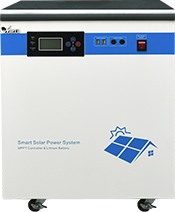


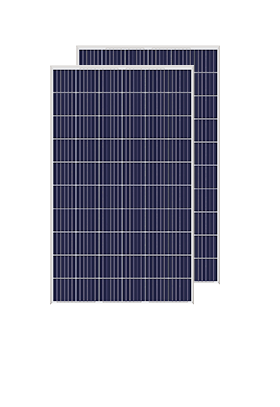



We have cooperated with more than 200 countries in solar energy projects and road lighting projects. We have exported products to many countries and participated in many important government projects around the world.




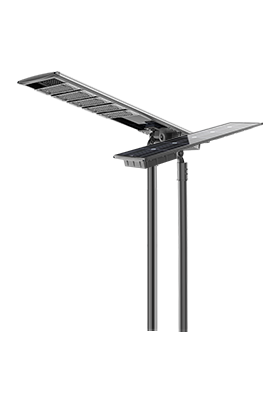


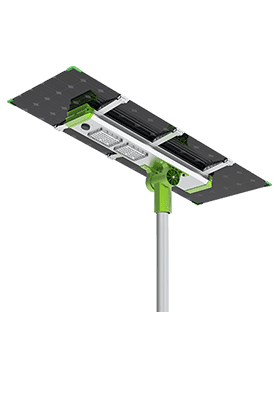
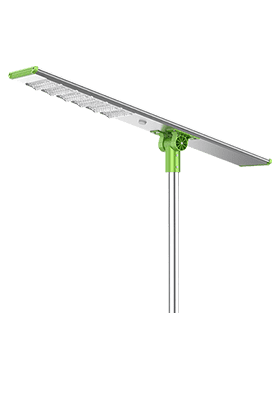
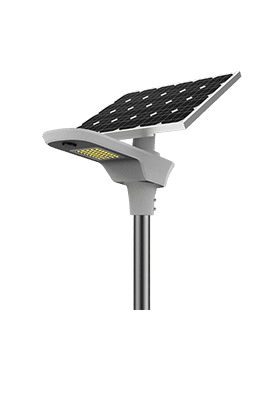


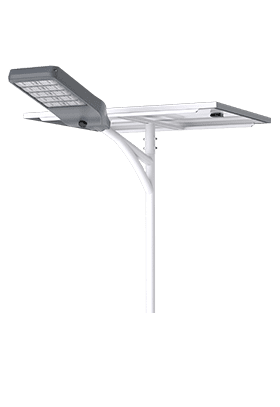
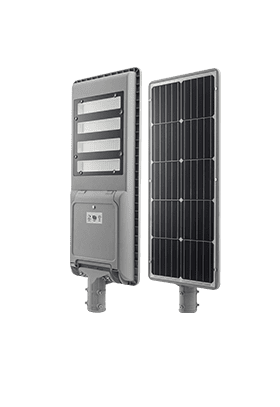
We have cooperated with more than 200 countries in solar energy projects and road lighting projects. We have exported products to many countries and participated in many important government projects around the world.

Anern has 17 years of experience in solar lighting and solar product manufacturing. Anern is headquartered in Guangzhou. With a production base of 30,000 square meters, our company has an R&D team of more than 100 people.
A solar battery stores the direct current (DC) electricity generated by your PV panels, making it available when the sun isn't shining. In modern energy storage systems, the battery determines how much backup power you have, how long your system can sustain critical loads, and what your total cost of ownership will be. Understanding how solar batteries work—and the key differences between available options—is the single most important step before making a purchasing decision.
A solar battery is a rechargeable energy storage device specifically designed to work with photovoltaic systems. Unlike a standard deep-cycle battery, solar batteries are engineered for frequent, deep discharge cycles and include integrated battery management systems (BMS) to monitor cell health, temperature, and state of charge.
Why you need one:
Without storage, a grid-tied solar system shuts down during a blackout (for safety reasons), and excess power generated during the day is exported to the grid—often at lower rates than what you pay to buy electricity at night. A solar battery changes this dynamic in three practical ways:
Self-consumption optimization – Store daytime excess for evening use, reducing grid purchases
Backup power protection – Keep critical loads running during outages (requires appropriate inverter configuration)
Peak shaving – Discharge stored energy during high-tariff periods to lower electricity bills
For commercial facilities, adding battery storage transforms solar from a daytime-only supplement into a 24-hour energy asset.
At its simplest level, a solar battery stores DC electricity through an electrochemical process. During charging, lithium ions move from the positive electrode (cathode) to the negative electrode (anode). During discharging, they flow back, releasing stored energy as electricity.
The complete charge/discharge cycle in a solar system:
PV generation – Solar panels produce DC power
MPPT optimization – A charge controller or hybrid inverter optimizes voltage and current from the panels
Battery charging – The optimized DC power flows into the battery according to a programmed profile
Inversion – When loads need AC power, the inverter draws DC from the battery and converts it to AC
Discharge control – The BMS prevents over-discharge and maintains balanced voltages across all cells
What the Battery Management System does that most buyers overlook:
The BMS is not optional—it is the safety and longevity brain of any modern lithium battery. A quality BMS provides:
Protection Function | What It Prevents | Why It Matters |
Over-voltage protection | Charging beyond max cell voltage | Prevents thermal events and capacity loss |
Under-voltage protection | Deep discharge below minimum voltage | Avoids irreversible cell damage |
Over-current protection | Excessive charge/discharge current | Protects internal connections and cells |
Temperature monitoring | Operation outside safe range | Extends cycle life; prevents shutdowns |
Cell balancing | Voltage drift between series-connected cells | Maximizes usable capacity |
For engineering buyers, verifying BMS communication compatibility (CAN bus or RS485) with your chosen inverter is essential—mismatched protocols are a common cause of field commissioning delays.
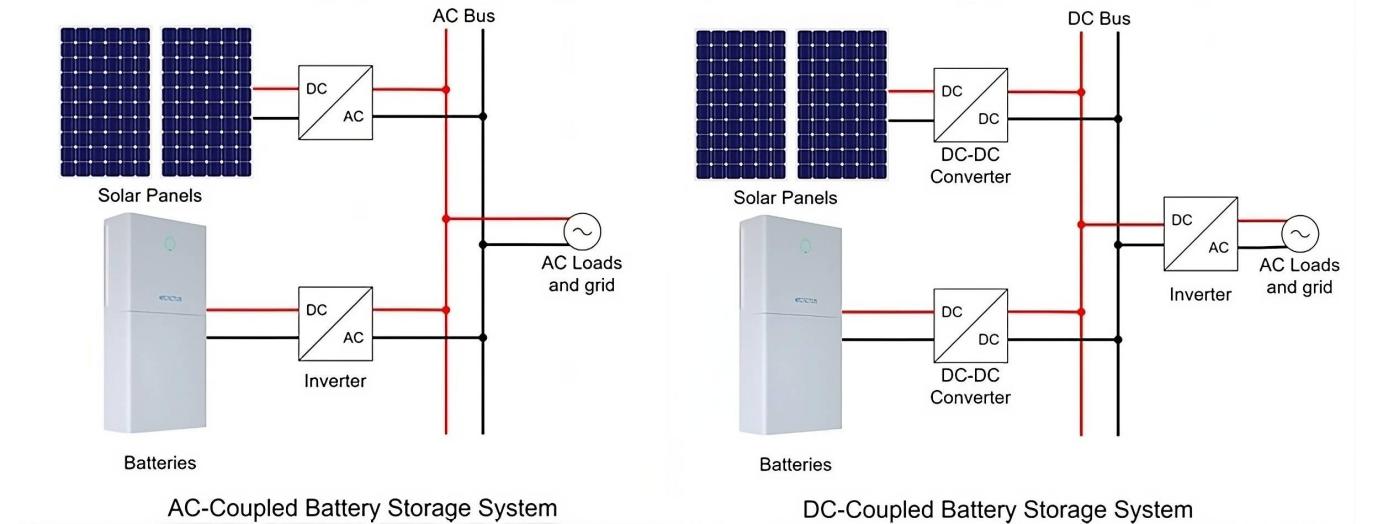
The coupling method determines how your battery connects to the solar system and the grid. This decision affects round-trip efficiency, backup capability, and retrofit feasibility.
DC-coupled storage – The battery connects to the DC side of the system, typically between the PV array and the hybrid inverter. When solar is generating, DC power can charge the battery directly without multiple DC-AC-DC conversions. For new installations where you are specifying both solar and storage together, DC coupling is generally more efficient (fewer conversion steps) and lower cost.
AC-coupled storage – The battery has its own dedicated battery inverter and connects to the AC side of the system. This is the common retrofit approach: you add a battery and a battery inverter to an existing grid-tied solar system that already has a PV inverter. Each time solar power goes into the battery, it undergoes two conversions: PV DC → AC (via existing inverter) → DC (via battery inverter).
Feature | DC-Coupled | AC-Coupled |
Round-trip efficiency | Typically 92-95% | Typically 88-91% |
Best for | New installations | Retrofits to existing solar |
Backup power during blackout | Yes (with hybrid inverter) | Yes (with battery inverter) |
Component count | Fewer (one hybrid inverter) | More (PV inverter + battery inverter) |
Which should you choose for a commercial project? For a new commercial build or complete system replacement, DC-coupled storage using a quality hybrid inverter is usually the better engineering choice.
Not automatically. Whether your battery provides power during a grid outage depends entirely on the inverter topology and how the system is wired.
Standard grid-tied battery systems – These use a hybrid inverter that can charge from solar and discharge to the grid or home loads under normal conditions. During a blackout, most are designed to disconnect from the grid (anti-islanding safety requirement) but can still power selected loads through an EPS (Emergency Power Supply) or backup output port—provided the inverter supports island mode and the backup loads are wired to a separate sub-panel.
What you need for blackout protection:
A hybrid or battery inverter with explicit EPS/backup capability
A critical loads sub-panel (separate from normal loads)
Proper transfer switching (internal to the inverter or external)
Sufficient battery capacity for your target backup duration
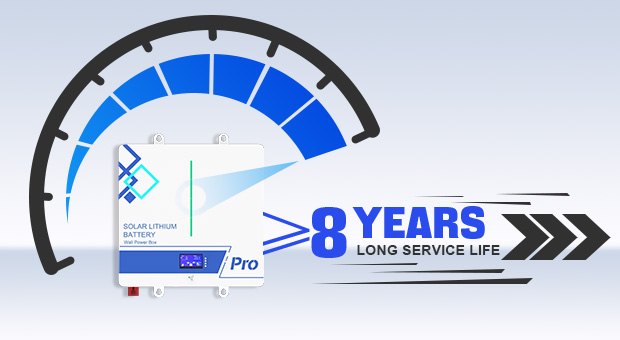
Battery lifespan is measured in two ways: cycle life (number of full charge/discharge cycles before capacity degrades to 80% of original) and calendar life (years of useful service regardless of cycles). For lithium iron phosphate (LiFePO₄) chemistry—the dominant choice in modern solar storage—both metrics are excellent.
Typical expectations with proper BMS management:
Usage Pattern | Expected Cycle Life | Approximate Calendar Life |
Daily cycling (self-consumption) | 6,000-8,000 cycles | 10-15 years |
Occasional backup (20-50 cycles/year) | Not cycle-limited | |
Heavy commercial use (2+ cycles/day) | 4,000-6,000 cycles | 8-12 years |
What degrades batteries faster: operating at extreme temperatures without thermal management; consistently discharging to very low states of charge (below 10-20%); sustained high C-rates; poor BMS design.
Comparing to lead-acid: While lead-acid has lower upfront cost, its cycle life is typically 500-1,000 cycles to 50% depth of discharge. A quality LiFePO₄ battery lasts 6 to 12 times longer. Over a 10-year project horizon, lithium's total cost of ownership is substantially lower.
This is a project-specific financial question, but the answer has shifted significantly as lithium battery prices have declined and electricity tariffs have become more volatile.
When solar batteries deliver clear ROI:
Time-of-use tariff arbitrage – Storing daytime solar and discharging during peak periods produces direct bill savings
Demand charge reduction – Commercial customers can use batteries to shave peak demand spikes, often saving hundreds or thousands monthly
Blackout-prone regions – For facilities where outages cause revenue loss, avoided downtime cost often justifies storage
Low feed-in tariff markets – When export rates are negligible, capturing your own solar energy is a financial hedge
Realistic payback ranges (2026 typical):
Residential: 8-12 years in moderate markets; 5-8 years with high peak rates
Commercial: 4-8 years with demand charge management
What to watch for in your analysis: ignoring battery cycle life; assuming 100% daily depth of discharge; overlooking round-trip efficiency losses (5-10% loss).
For engineering buyers and commercial project developers, selecting the right storage platform means matching capacity, voltage class, and form factor to specific load profiles and site constraints. Below are three commercial solar battery lines that illustrate the range of available options.
Commercial Solar Battery Storage (General Line)
Specification | Detail |
Key feature | Integrated "generation-storage-consumption" cycle with BMS |
Technology | MPPT-compatible, long-life lithium-ion |
Installation | Modular, on-demand expansion |
Suitable scenarios | Small commercial (convenience stores) to large industrial (manufacturing plants) |
Key advantage | Multiple protection design; international safety certification |
This general commercial line is appropriate for facilities where the primary goal is daily self-consumption and peak shaving. The integrated design—combining battery modules with a compatible BMS—reduces engineering complexity during commissioning.
High-Voltage Commercial Solar Battery、
Specification | Detail |
Rated capacity | 215 kWh |
Rated power | 100 kW |
Voltage class | High-voltage |
Target application | Large commercial, light industrial, multi-tenant buildings |
Key advantage | High power output enables simultaneous heavy loads; scalable for microgrids |
High-voltage batteries offer higher round-trip efficiency and lower cabling costs than low-voltage parallel strings. The 100kW power rating means this battery can support significant load steps—running multiple HVAC units, commercial kitchen equipment, or workshop machinery simultaneously during discharge.
Feature | Rack-Mounted (AN-LPB-R series) | Typical Wall-Mounted Unit |
Installation | Standard 19-inch rack or cabinet | Wall bracket |
Voltage capability | Series/parallel for high voltage (data centers, base stations) | Typically low-voltage (48V nominal) |
Modular expansion | Multiple units, automatic address acquisition | Limited parallel units |
BMS communication | CAN/RS485 with mainstream inverter brands | Varies |
Temperature range | -20°C to 60°C | Typically 0°C to 50°C |
Cycle life vs lead-acid | 20x cycle life, 5x float life | N/A |
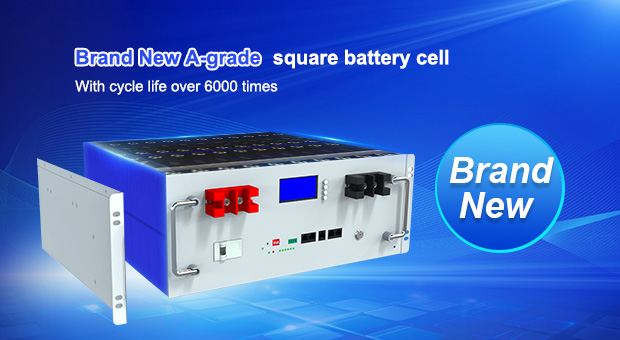
Rack-mounted batteries are the right choice when you need standardized, dense energy storage that can be serviced by facility staff familiar with server-rack form factors. Common use cases include telecom base stations, data center UPS augmentation, and multi-unit commercial storage (grocery chains, retail stores) where consistent form factor simplifies maintenance.
Procurement checklist before buying any commercial battery:
Battery chemistry (LiFePO₄ recommended)
Voltage class compatibility with your inverter
BMS communication protocol (CAN or RS485)
Maximum charge/discharge current vs your peak load
Operating temperature range for your installation environment
Cycle life guarantee (stated cycles to 80% capacity at defined DoD)
Solar batteries work by storing DC electricity from PV panels, managed by an intelligent BMS, and delivering it back as AC power through a compatible inverter. The difference between a system that reliably saves money for a decade and one that generates service calls comes down to informed specification: choosing the right coupling method (AC or DC), the right chemistry and form factor, and verifying compatibility down to the communication protocol level.
The most direct path to a successful commercial solar storage project is simple: match the battery's voltage class, power rating, and communication protocol to your inverter and loads, then validate the cycle life against your expected daily usage.
How many solar batteries do I need for my commercial facility?
Calculate your target backup kWh (critical loads × hours of runtime) or daily self-consumption kWh. Divide by the battery's usable capacity (allow 10-20% buffer). For 100kW+ facilities, a single 215kWh battery often suffices for peak shaving; backup may require multiple units.
Can I add solar batteries to an existing solar system later?
Yes—AC-coupled storage is designed for this scenario. You add a battery inverter and battery bank on the AC side of your existing PV inverter. Efficiency is slightly lower than DC-coupled new builds, but the retrofit is straightforward.
What maintenance do solar batteries require?
Quality LiFePO₄ batteries with good BMS are effectively maintenance-free. The BMS handles cell balancing, temperature monitoring, and protection. Annual checks should verify ventilation is unobstructed and communications are reporting correctly.
Do solar batteries work in cold weather?
LiFePO₄ batteries can operate from -20°C to 60°C, but charging below 0°C requires built-in heating or current derating. If batteries are in an unconditioned space that freezes, select a model with self-heating or locate them in a temperature-controlled environment.
How do I know if my battery is compatible with my inverter?
Check three things: first voltage range match, second BMS communication protocol (CAN or RS485) compatibility, and third maximum charge/discharge current (battery rating should meet or exceed the inverter's battery port rating). Use manufacturer-published compatibility lists when available.